Category: Program

Plenary Speakers

Program Plenary Speakers

The ASC 2026 Conference continues our long-standing tradition of creating an exciting program including a slate of vibrant plenary speakers, who will present high-level overviews on topics the program committees consider as critical for both near-future and next-generation applications.  Perspectives will be addressed by the plenary speakers, on remarkable past progress, present developments and challenges, and future needs and emerging applications and niches that lie ahead.  The program committees are very pleased and honored to introduce ASC 2026 plenary speakers who have accepted to speak thus far, and their tentative presentation titles.


40th Anniversary of Cuprate Superconductors: The Discovery, the Present and the Future

Paul C. W. Chu
Texas Center for Superconductivity, University of Houston Science Center


Collaboration Modes in Superconductivity, Applications to Large-Scale

Lucio Rossi 
University of Milan / INFN – Istituto Nazionale di Fisica Nucleare


Current Status and Future of Quantum Computing

Irfan Siddiqi
University of California-Berkeley, Department of Physics


Current Status and Future of Superconducting Electronics

Samuel Benz
NIST-Boulder, Superconductive Electronics Group


Special & Memorial Sessions

Special Session Announcements

The ASC 2026 program committee is organizing a series of special sessions which will be of interest to various attendees, including engineers/scientists, system-level developers, and industry-level representatives. These sessions will feature both special invited presentations and contributed talks.

In addition, ASC 2026 will be holding memorial sessions to honor remarkable individuals who made significant contributions to the field of applied superconductivity but have since passed away.

Please refer to the list of special and memorial sessions below.

ASC 2026 JOINT SPECIAL SESSIONS

40 Years of Cuprate Superconductors: Achievements, Challenges and Future Perspectives

This joint special session celebrates the 40th anniversary of the discovery of cuprate superconductors, a landmark breakthrough that transformed the landscape of condensed matter physics and materials science and enabled major advances in superconducting technologies. The session aims to bring together researchers, industry leaders, and technologists to reflect on the remarkable progress achieved over the past four decades and to envision the challenges and opportunities that lie ahead.

Leading experts will review key milestones, including materials development pathways that have enabled cuprates to evolve from fundamental research toward industrial-scale production, advances in electronic devices, and the growing potential for large-scale applications. Speakers will discuss the scientific challenges that have been overcome, the remaining barriers that limit broader deployment, and the emerging niches where cuprate superconductors can deliver significant technological impact.

The session will conclude with a forward-looking and provocative discussion highlighting priorities for the coming years aimed at identifying strategies to accelerate innovation and application. This anniversary provides a timely opportunity to reflect on the legacy of cuprates and to shape a shared vision for their continued contribution to science and society

Organized by: Teresa Puig (ICMAB-CSIC) and Rochelle Qu (University of California-Riverside), and David Larbalestier (NHMFL/FSU)

HTS Standards

The session objective is the initiation of a long-term effort to develop the community-accepted HTS property definitions and test methods that will be eventually accumulated as the 61788 IEC Standards.

Organized by: Michael Parizh (GE Healthcare) & Ziad Melhelm (Oxford Quantum Solutions)

HTS Tapes in Coil Systems: Performance Requirements and Practical Limitations

In the expanding field of high-temperature superconductor (HTS) tape applications, coil technologies impose particularly demanding requirements on tape performance. Key factors include consistent critical current along the entire tape length, uniform geometrical and intrinsic properties, and the availability of long, defect-free lengths. Electro-mechanical performance is especially critical, as HTS tapes must withstand various types of applied stress—such as delamination, hoop, and compressive stress, as well as combinations of these.

Thermal stability and quench protection are also widely discussed within the HTS community. Alongside these challenges, reliable joint technologies for connecting individual tapes or HTS cables remain essential for coil systems, whether in compact high-field magnets, large fusion devices, or accelerator coils. For accelerator applications, mitigating AC losses is a key issue that must be addressed to enable the practical adoption of HTS tapes.

Because HTS tapes must operate within a structural environment, the properties of the surrounding materials must also be carefully evaluated. These considerations, together with comprehensive modelling of the entire assembly, are essential for designing a reliable coil architecture.

In this special session, these topics are addressed to provide a comprehensive understanding of the current status and practical limitations of HTS tapes for coils applications.

Organized by: Nadezda Bagrets (KIT) and Arend Nijhuis (University of Twente)

Radiation Issues for Superconducting Fusion Magnets

Nuclear fusion based on magnetically confined plasma has attracted renewed interest because of the urgent need for renewable, emission free energy sources. The commercial availability of HTS wires is key for the development of affordable fusion reactors because of their ability to generate large fields leading to a higher power density in the plasma that enables more compact reactor designs. However, a compact design leads to a high radiation load and challenges the materials surrounding the plasma, in particular the superconductors of the toroidal magnet system. This special session aims at giving an overview on the current knowledge about the expected radiation environment, the induced damage and the resulting changes of the properties of the used materials.

Organized by: Michael Eisterer (TU Wien, Atominstitut) and Soren Prestemon (LBNL)

ASC 2026 ELECTRONICS SPECIAL SESSIONS

40 Years of High-Tc Electronics – In Memory of Robert C. Dynes

The year 2026 marks forty years since the discovery of high-temperature superconductivity in YBa₂Cu₃O₇₋ₓ (YBCO), an achievement that transformed the landscape of superconducting electronics. Over these four decades, remarkable progress has been made in developing high-Tc junctions, SQUIDs, and hybrid systems that continue to push the boundaries of performance and application. This session will celebrate the history and evolution of high-Tc electronics, from early breakthroughs to emerging frontiers, and explore where the field may be headed in the next generation of devices and applications.

The session is dedicated to the memory of Robert C. Dynes, whose pioneering research and lifelong support for high-Tc superconductivity have inspired generations of scientists and engineers working in superconducting electronics.

Organized by: Ethan Cho (Northrop Grumman) and Han Cai (University of Maryland)

Applications of SQUIDs from Biomedical Imaging to Geophysical Measurements

Superconducting quantum interference devices (SQUIDs) remain the most sensitive magnetic flux sensors available, finding applications across an extraordinary range of scientific and industrial fields. This session will highlight how SQUID technology continues to advance and diversify — from biomedical imaging and brain mapping to geophysical surveys for mineral exploration or geotechnical applications, nondestructive evaluation, and precision materials characterization.

Topics include any applications of SQUIDs, such as biomedical instrumentation (MEG, ULF-MRI), geophysical measurements (e.g., exploration for minerals, oil and gas, geothermal reservoirs), environmental and materials sensing, and emerging uses in navigation, metrology, non-destructive evaluation, and quantum-limited detection. Presentations will emphasize innovations in device design, cryogenic integration, and noise reduction that expand SQUID performance into new domains and environments.

Organized by: Ronny Stolz (Leipniz IPHT) and Sabu Tanaka (Toyohashi University of Technology)

Artificial Intelligence Enabled by Superconducting Electronics

Artificial intelligence is driving an unprecedented demand for computing power. As models grow larger and more complex, conventional semiconductor technology is reaching its limits in both speed and energy efficiency. Superconducting electronics offers a fundamentally different approach to meeting these challenges. With nearly lossless interconnects, picosecond switching, and cryogenic operation, these systems have the potential to deliver extremely high performance while consuming only a fraction of the power required by traditional processors.

This session will examine how superconducting digital and optoelectronic technologies could form the foundation of future AI hardware. Topics include neuromorphic architectures, cryogenic computing platforms, superconducting logic for AI acceleration, and hybrid systems that combine superconducting and semiconductor technologies. The session will provide a forum to discuss where the field stands today, what technical and engineering barriers remain, and how superconducting electronics might ultimately enable scalable, energy-efficient artificial intelligence.

Organized by: Elie Track (IEEE CSC/nVizix) and Olivia Chen (Tokyo City University)

Flux Trapping and Mitigation Strategies in Superconducting Digital Electronics

Flux trapping remains a fundamental challenge in the design and fabrication of large-scale superconducting digital electronics. Magnetic vortices trapped during cooldown or device operation can introduce variability, excess noise, and logic failure in complex circuits. This session will examine the mechanisms of flux trapping in superconducting thin films and junction structures, and highlight recent advances in device design, fabrication, and layout strategies that mitigate or control these effects.

Topics of interest include the characterization of flux-trapping modes, fabrication-process optimization, geometric and material design for improved flux resilience, and new imaging and diagnostic techniques for visualizing trapped flux and vortex dynamics. Simulation and modeling approaches that connect device physics to circuit performance are also encouraged.

Organized by: Nobuyuki Yoshikawa (Yokohama National University) and Igor Vernik (Seeqc, Inc.)

Interfacing Qubits with Superconducting Digital Logic

A major challenge in scaling superconducting quantum computing is the complexity of interconnects required for control, readout, and feedback as the number of qubits grows. Traditional wiring architectures limit scalability, while room-temperature electronics impose bandwidth and thermal constraints. Superconducting digital logic offers a promising path forward by enabling fast, low-power, cryogenic signal processing and routing directly adjacent to the qubit plane.

This session focuses on circuit- and system-level strategies for integrating superconducting digital electronics with quantum devices. Topics include cryogenic control interfaces, multiplexed readout architectures, SFQ-based signal generation and routing, co-fabricated quantum–classical chips, and hybrid system designs that reduce lead count while maintaining high fidelity.

Organized by: Oleg Mukhanov (Seeqc, Inc.) and Mike Hamilton (Google)

Ion Beams in Superconducting Device Fabrication

Ion Beams in Superconducting Device Fabrication Ion beams have become a powerful and versatile tool in the micro- and nanofabrication of superconducting devices. Focused ion beam (FIB) milling, gas-assisted deposition, and ion irradiation enable patterning and property tuning with nanometer precision, offering pathways for engineering Josephson junctions, nanowires, and hybrid superconducting structures beyond the
limits of conventional lithography.

This session will highlight recent progress in ion-based fabrication of superconducting devices, with emphasis on reproducible junction formation, nanoscale patterning, and controlled defect engineering. Topics include irradiation-induced superconducting-to-normal transitions, localized amorphization and regrowth, ion-beam-assisted material modification, and direct-write metallization for circuit prototyping.

Organized by: Jay LeFebvre (University of California) and Wolfgang Lang (University of Vienna)

TES Workshop

The TES (Transition-Edge Sensor) Workshop, a long-standing tradition at ASC, provides a focused forum for presenting, discussing, and synthesizing advances in superconducting detector technologies. Transition-edge sensors, operating in the sharp resistive transition between their superconducting and normal states, are exquisitely sensitive to energy deposition, making them central to cutting-edge applications such as cosmic microwave background (CMB) measurements, X-ray and gamma spectroscopy, quantum information systems, and rare event searches.

Since its incorporation into ASC in 2008, the workshop has expanded to include related detector technologies (e.g. kinetic inductance detectors, magnetic calorimeters, and hot-electron bolometers) that share design, readout, or physics overlaps with TES systems. This session will cover device physics, readout techniques, fabrication strategies, system integration, and new application frontiers.

We invite contributors to present original work on TES design, performance, multiplexing architectures, module integration, cryogenic instrumentation, and application-driven deployment. The goal is to promote cross-community dialogue, identify challenges and opportunities, and chart the roadmap for next-generation superconducting detector systems.

Organized by: Paul Szypryt (NIST), Shannon Duff (NIST), Douglas Bennett (NIST), Kaja Rotermund (LBNL), Johanna Nagy (Case Western), and Thomas Cecil (ANL)

ASC 2026 LARGE SCALE SPECIAL SESSIONS

Conduction-Cooled Superconducting Applications: Is there a Practical Limit?

This session will explore whether current demonstrations and plans indicate that cryocoolers can effectively operate at temperatures above 4.2 K. It will also consider the challenges of deploying these systems in environments where power and resources are limited.

Organized by: Michael Green (LBNL)

Electrical Integrity in Large-Scale Devices

Research on the impact of insulation on superconducting magnets and power applications will be presented. This includes current findings and lessons learned that often receive insufficient attention as we focus primarily on superconducting materials and cryogenics, while dielectrics are considered to a lesser extent.

Organized by: Roland Piccin (CERN)

HL-LHC IT STRING:  A Key Milestone towards New Accelerators Paving the Road of New Technologies

The High-Luminosity LHC (HL-LHC) demands a new generation of accelerator technologies, components, and integration strategies. This special session presents a coherent overview of the full development chain: from early R&D to final products, for several key systems The selected contributions illustrate how innovative concepts have been matured, validated, and transformed into deployable solutions through extensive prototyping, qualification campaigns, and system-level evaluations.

A central element of this pathway is the HL-LHC IT String, the first global integration test reproducing the full cryogenic, powering, protection, and control environment of the HL-LHC Inner Triplet. By bringing together components produced by multiple institutes and industries, the IT String provides an essential demonstration of performance, reliability, and operational readiness in conditions representative of the final machine. The session highlights how the results obtained in this integrated test confirm the maturity of the technologies presented and mark a decisive milestone toward installation in the HL-LHC.

Beyond validating HL-LHC hardware, these achievements also establish methods, technologies, and manufacturing approaches that will be crucial for next-generation accelerators. Together, the talks offer a comprehensive perspective on how coordinated R&D, industrialization, and system integration pave the road toward future high-performance accelerator infrastructures.

Organized by: Marta Bajko (CERN)

Next Generation Magnets for Fusion: Is 20 K a Magic Temperature?

Many applications are converging around the 20 K temperature point. What makes this temperature significant from a performance standpoint? Are there benefits to using liquid hydrogen instead of cold helium gas that are worth exploring?

Organized by: Valentina Corato (ENEA), Charlie Sanabria (CFS), and Nicolò Riva (Proxima Fusion)

HTS Magnets for NMR and MRI

Benefits, prospects, and challenges of HTS MRI, HTS NMR; Current technology development and commercial demonstrations with discussion of long-term prospects of ReBCO applications for MRI and NMR. Discussing the applications and advancements of ReBCO (Rare Earth Barium Copper Oxide) in the field of MRI and NMR magnets.

Organized by: Anbo Wu (GE Healthcare) and Robert Herzog (Bruker)

Superconducting Machines for Aircraft Propulsion – In Memory of Gerald V. Brown

This session memorializes Dr. Gerald V. Brown and his dedication to developing superconducting electric machines for producing thrust in future commercial aircraft. During his 65-year career at NASA Glenn Research Center, Gerry invented the magnetic heat pump, contributed to the Apollo and space shuttle programs, and spent over 20 years advancing superconducting machines, guiding the development of low AC loss superconductors, and conceptualizing superconducting propulsion systems. Gerry was one of the three originators of NASA’s N3-X turboelectric, hybrid-wing-body concept aircraft.

This session will showcase the progress on low AC loss superconductors, cryogenic armatures, and superconducting machines that has and is continuing to be made for aircraft propulsion as well as Gerry’s impact on the people and technology in this field.

Organized by: Justin Scheidler (NASA Glenn Research Center) and Thanatheepan Balachandran (Hinetics, Inc.)

Transforming Energy Systems: of Superconductivity in Future Power Grids and Transportation

Superconductivity is an enabling technology for many sectors in the generation, transmission, and distribution of electrical power. The value proposition for its utilization can be high especially for propulsion applications where mass and system efficiency are critical factors; however, has had many challenges since the discovery of high temperature superconductors. There has been an increase in its utilization across electrical networks in both stationary and transportation environments and this session will provide a forum to highlight current efforts and future utilization of superconductivity in grid and transportation applications.

Organized by: Robert Duckworth (ORNL) and Timothy Haugan (U.S. AFRL, retired)

ASC 2026 MATERIALS SPECIAL SESSIONS

20 Years Anniversary of Iron Based Superconductors

This year marks the 20th anniversary of the discovery of the iron-based superconductor LaFePO. Iron-based superconductors exhibit critical temperatures, Tc, second only to those of cuprate superconductors under ambient pressure and have attracted sustained attention for both fundamental research and practical applications. In recent years, the development of iron-based superconducting wires has advanced rapidly, with performance exceeding that of Bi-based counterparts. At the same time, challenges remain, such as the inclusion of arsenic (As) as a constituent element. To commemorate the 20th anniversary of iron-based superconductivity, this symposium will provide a forum to share current understanding of their properties, advances in performance, and prospects for applications. In addition to invited talks, a panel discussion will be held to address the remaining issues and explore future directions toward practical utilization.

Organized by: Kazumasa Iida (Nihon University) and Valeria Braccini (CNR-SPIN)

Data-Driven Approaches for Next-Generation Superconducting Materials Research

Data-driven and machine-learning-assisted methods are rapidly transforming the discovery, design, optimization, synthesis, and characterization of superconducting materials. This special session highlights recent advances in data-driven approaches for next-generation superconducting materials, featuring prominent researchers working in this rapidly developing area of research. The format will include short invited talks and a panel discussion on future directions, data quality and reproducibility, and challenges of deploying data-driven workflows in superconducting materials research.

Organized by: Mark Ainslie (King’s College London) and Akiyasu Yamamoto (Tokyo University of Agriculture and Technology)

Remembering Robert Hammond: A Tribute to His Contributions to the Superconductivity Community

This session memorializes Dr. Robert (Bob) Hammond and his remarkable career in applied superconductivity. Speakers will highlight Bob’s creativity in developing and applying advance thin-film deposition to increasingly  complex materials, his major scientific contributions from his early career onward, and his seminal work on ReBCO coated conductors. The session will also reflect on Bob’s impact as a mentor and conclude with perspectives on the future inspired by his legacy. Bob received his B.S. in 1953 and his Ph.D. in 1960 in Physics from University of California, Berkeley. He worked at General Atomics from 1960 to 1968, and later at UC Berkeley 1968-1971 as a Lecturer. In 1971 he joined Stanford University where he enjoyed the remainder of his career. His career interests spanned many different areas of science and technology with the goal of making practical superconducting materials, especially thin films. His seminal contributions included work on amorphous superconductors, A15 compounds, high-temperature cuprate superconductors (HTS), as well as other novel superconducting materials. He pioneered a new scientific field in Ion Beam Assisted Deposition (IBAD) for thin film crystal alignment, a breakthrough that enabled the practical application of HTS tapes. In 2018, he was awarded IEEE James Wong Award for Continuing and Significant Contributions to Applied Superconductor Materials Technology. Bob was the author or co-author of over 1,000 scientific articles and held numerous patents.

Many generations of Stanford University graduate students and postdocs benefitted greatly from Bob’s mentorship in the lab. His dedication and example inspired them to pursue science at a critical stage in their careers. He thrived in the laboratory environment, working side by side with younger colleagues and guiding them with his patience, generosity, and passion. Bob was a humble person with big bold visions – an inspiring combination that left a lasting mark on all who knew him.

Organized by: Vladimir Matias (iBeam Materials, Inc.) and Malcolm Beasley (Stanford University)

Awards

Awards Presented at ASC 2026

A number of awards and prizes will be presented to outstanding engineers, scientists, and managers who have made significant contributions to the success of the field of applied superconductivity.

IEEE Awards


The following IEEE Awards will be presented at ASC 2026: 

Nominations are accepted until February 28 of the year in which the award will be presented (unless extension announced). Please visit the IEEE CSC website for full descriptions and nomination procedures of the awards.

Cryogenic Society of America Roger W. Boom Award


The Roger W. Boom Award is named in honor of the late emeritus professor from the University of Wisconsin. Dr. Boom’s career spanned more than thirty years during which he motivated a great number of young scientists and engineers to pursue careers in cryogenic engineering and applied superconductivity. This award was created by the CSA to be given to a young professional (under 40 years of age) who “shows promise for making significant contributions to the fields of cryogenic engineering and applied superconductivity. The spirit of the Boom Award is to recognize young people for their pursuit of excellence, demonstration of high standards and clear communications.

Nominations Open: March 2, 2026
Nominations Close: May 1, 2026

Please visit the CSA website for more information.

Jan Evetts SuST Award 2026


In 2017, the 30th Anniversary of Superconductor Science and Technology (SuST) was marked by the launch of the Jan Evetts Award, established to recognise the best paper published in SuST by an early career researcher. The award is in fond memory of SuST’s founding Editor, Professor Jan Evetts, who made exceptional contributions to the science of superconductivity, advanced the understanding of superconducting materials, and championed the development of superconductivity applications throughout his career.

The award aims to continue Jan’s legacy of fostering a strong, collaborative community in superconductivity, by celebrating emerging talent in the field. The award winners will be announced be at ASC 2026.

  • 1st Prize: Certificate and a cash prize of £500.
  • 2nd Certificate and a cash prize of £300.
  • 3rd Prize: Certificate and a cash prize of £100.

Entry Criteria
The competition is open to all researchers working in superconductivity (within the scope of SuST) who meet the following criteria:

  • Applicants must have completed no more than 10 years of active research following the award of their PhD.
  • The applicant must be the lead author of the paper (though not necessarily the first author)
  • The submission window is open until 31 May 2026.
  • Only original research papers will be considered.
  • All submissions must include a cover letter that states which author is applying for the award, the year of PhD completion and the applicant’s scientific contribution to the research presented in the submitted paper.

Further information and submission details are available on the focus collection webpage.

Authors & Program

Program - Overview

ASC 2026 Program Chair’s Welcome

We are proud to welcome you to ASC 2026 in Pittsburgh! The conference will offer a forum for sharing and discussing the latest updates and news in the field of applied superconductivity. As the world is in a transition period regarding future energy systems and our life choices (the way we live, move, eat, build and power things), we would like to support discussions on how superconducting solutions can contribute to a more sustainable world and what can be done as a scientific community. The unique phenomenon of superconductivity continues to provide new solutions for more efficient and novel technologies of energy, power, magnets, computing, electronics, detector, and other fields.

We are working together with the conference chair, the Large Scale, Materials and Electronics topical chairs and with the volunteer scientific program committee members to create an inspiring technical program and a welcoming event for all attendees. Breaking plenaries, engaging talks and posters will be part of the program.

Special sessions are being curated, to highlight select research fields. We encourage your suggestions, so feel free to contact us.

Check back for updates as the program develops, and our wholehearted welcome to Pittsburgh!

– Timothy Haugan


The program committees are very pleased and honored to introduce ASC 2026 plenary speakers. Click here for details.

ASC 2026 will feature special and memorial sessions honoring key contributors to applied superconductivity. View the list of special sessions here.

Abstract submission opens December 10, 2025. The deadline has been extended to February 2, 2026. Click here for more information.

Want to be part of this event? Contact us for possibilities!

Technical Program

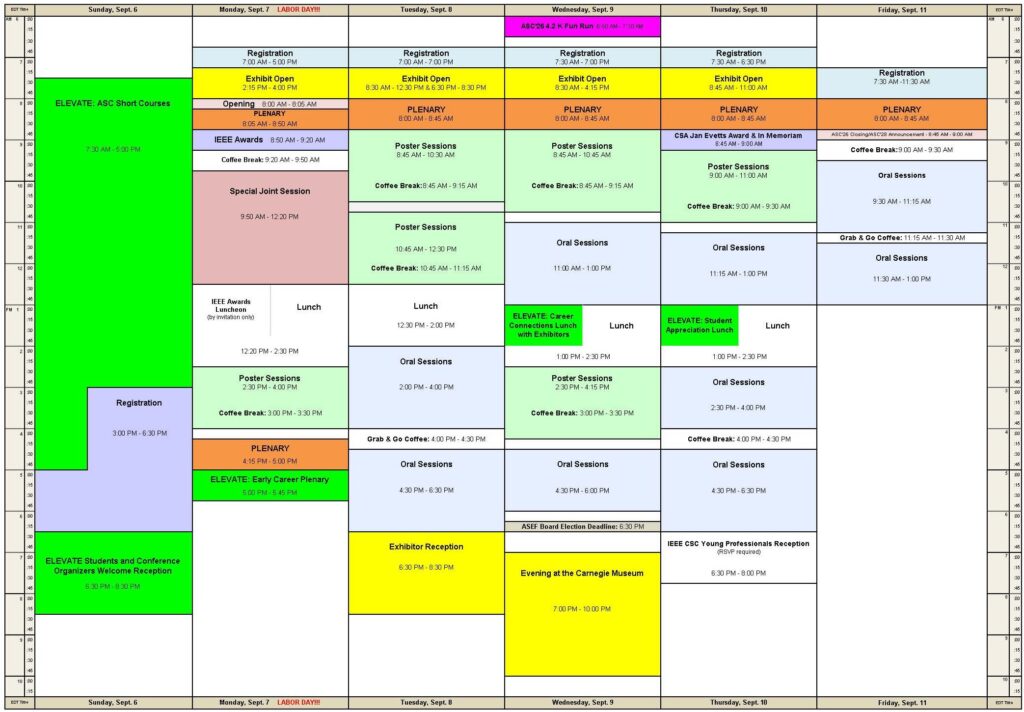
Technical Program & Agenda

The ASC 2026 Conference Organizers & Program Committee occasionally need to make changes to the program. We urge you to check the schedule before and during the conference for last minute changes.

Special & Memorial Sessions

The ASC 2026 program committee is organizing a series of special sessions which will be of interest to various attendees, including engineers/scientists, system-level developers, and industry-level representatives. These sessions will feature both special invited presentations and contributed talks. In addition, ASC 2026 will be holding memorial sessions to honor remarkable individuals who made significant contributions to the field of applied superconductivity but have since passed away. Click here for details.

Click on the image below to open the Draft Schedule at a Glance in PDF format.


Further information about the Technical Program will be posted soon. Please check back. 

Authors

Authors

General Information

  • Abstract submission opens Wednesday, December 10, 2025. 
  • Virtual Abstract Writing Workshop: A free Virtual Abstract Writing Workshop will be offered on January 15, 2026, to support students and early-career professionals in developing high-quality abstracts. The workshop will provide examples of effective abstracts, highlight common pitfalls, and offer practical guidance for non-native English speakers. Participation is optional but strongly encouraged for all prospective authors. Click here for details.
  • All authors identified as speaker/presenting author on the accepted abstract must register for the conference and be present in Pittsburgh, virtual or hybrid format for presentations is not supported.
  • Presentations are either oral or poster. The Program Committee reserves the right to change the type of presentation from that preferred by the author to accommodate limitations on meeting space and other constraints.
  • Presentation is a requirement for a submitted manuscript to be considered for peer review. This includes presentations in oral or poster format. The presentation should be given at the appointed time in the program, by the designated author or co-author (presenter). Only manuscripts based on material presented in an oral presentation or on a poster will be considered for publication. For posters, the word “presented” means that the presenting author must be present during the entire session and available for discussion. Simply posting an enlarged version of the manuscript is not considered as a presentation. The abstract submitter will become the contact author for the manuscript submission. Manuscript submission is not required.
  • Abstract submission extended deadline: 11:59 PM EST, Monday, February 2, 2026.  This deadline is firm! Abstract submissions are no longer accepted except for the extreme circumstance of presenting last minute, ground-breaking research. In such cases, please contact Centennial Conferences by email with your abstract be sure to include the appropriate submission category. Abstracts will be sent to the Program Committee Chairs for possible consideration at the committee’s discretion.
  • After the abstract submission deadline, abstracts will no longer be accepted except for the extreme circumstance of presenting last minute, ground-breaking research.
  • Oral and Poster presentation guidelines will be posted at a later date.
  • Abstract acceptance notifications will be emailed to the submitting and presenting authors on March 16, 2026.
  • Acceptance of an abstract and its presentation (whether oral or poster) does not guarantee that the related manuscript will be accepted for publication.
  • Manuscript preparation and submission information will be posted at a later date here.


Abstract Submission Extended deadline February 2

CALL FOR ABSTRACTS & PAPERS

Submissions shall generally address at least one of the areas below. Click here for the full list of submission categories.

  1. Applications of superconductors in Quantum Systems – Quantum Computing / Communications / Sensing. The most promising modalities for implementing the relatively new field of quantum information involve superconducting devices, superconducting qubits, and/or superconducting readout systems. ASC invites submissions related to Quantum Systems that include superconductors. Device, design, packaging, system related topics are included and solicited.
  2. Advances in the science of superconductors relevant to applications. Abstracts describing basic materials, films, or artificial structures should discuss properties interesting for applications, forms used in applications such as elementary conductors or simple circuits, or structural or compositional aspects that potentially lead to use in a device. Theoretical content should address topics relevant to applications, operations, or behavior of practical systems. Experimental studies, test methods, and data should relate to aspects of superconductivity important for applications in some way.
  3. Advances in superconducting technology. Abstracts may describe concepts, design, modelling, manufacturing or fabrication, and operation or implementation of superconducting devices or components. Extensions of conventional technologies by the use of superconductivity should emphasize the role of superconductivity in the device or component. Abstracts may describe non-superconducting technologies that are required for the use of superconductors, such as insulation, provided that the primary discussion is focused on applied superconductivity.
  4. Integration of superconducting devices and components in systems. Abstracts may discuss sub-systems or full systems comprised of components such as cables, magnets, detectors, circuits, and so on. Discussions may include components and processes that support superconducting devices, such as cryogenic systems supporting superconducting magnets. Studies of power devices, transportation systems, electricity transmission, energy storage, and other systems that use superconducting components should emphasize the role of superconductivity or the particular aspects of superconductivity important to the system or application. Cryogenics, non-superconducting materials at cryogenic temperature, power supplies, power electronics, and other ancillary topics may be considered provided the connection to applied superconductivity is clear. Also, abstracts may describe facilities to verify operation of components, report system tests, or describe the status of superconducting systems and projects using superconducting components.

Note that the numbers are related to editorial subject areas of the IEEE Transactions of Applied Superconductivity (TAS). A submission category must be selected during abstract submission.

Abstract Preparation & Submission Guidelines

  • All abstracts must be about applied superconductivity, must be written in the English language, must contain enough information to permit placement of the presentation into the program, and must make logical arguments based on scientific or engineering methods. The Program Committee reserves the right to reject abstracts that do not conform to these guidelines.
  • Abstracts must be submitted via the ASC 2026 abstract submission site.
  • Only the abstract title, abstract body (text only), and authors are required.
  • Abstract Submission Checklist:
    • Ensure your abstract contains sufficient information for reviewers to determine its scientific quality.
    • Ensure your abstract is about applied superconductivity and explain the relevance.
    • Ensure your abstract is scientifically meaningful or otherwise descriptive of a substantial development in the ASC community and does it explain why.
    • Length restrictions include spaces and are as follows:

♦ Title and Abstract Content/Body: 3000 characters
♦ Acknowledgment: 300 characters

  • Formatting may be performed by the abstract management system, please prepare your abstract in plain text.
  • Abstract titles must be in mixed/sentence case.
  • Some symbols (e.g., Greek letters) can be used in the abstract submission, however, if your symbol does not paste correctly (you should be able to see it on the screen), then please substitute the corresponding plain text.
  • All co-authors must be included in the abstract submission site with a valid email address. If you have a large collaboration author list, you may provide a collaboration email address. However, only authors explicitly entered into the submission site will be displayed in the online planner for attendee viewing.
  • A confirmation step will permit authors to verify all content and give final approval. Only completed submissions will be reviewed for technical program consideration. Draft submissions will not be considered.
  • Submitting authors are responsible for the accuracy of all submitted information.
  • The control number assigned to an abstract once it is submitted is the primary means of identifying an abstract until the program is formed. Please use the control number in any correspondence concerning abstracts until a program number has been issued.

Abstract Changes & Withdrawals

Abstract Changes & Modifications

Abstracts may be modified until the deadline using the abstract submission site unless the submission has already been reviewed by the Program Committee.

If your abstract has already been reviewed and after the submission deadline, abstract content changes, i.e., modification of title or body, will be sent to the Program Committee for approval. Corrections, i.e., spelling or grammar, or author changes such as designation of different presenting author, changes to affiliations, changes to names, etc., can be completed without referral to the Program Committee. In either case, please contact Centennial Conferences by e-mail and specify whether you need a change or a correction in the e-mail subject line along with the Control ID.

Except for presenting author changes, modest abstract modifications will be accepted until August 3, 2026.

Abstract Withdrawals

  • Abstracts can be withdrawn via the abstract submission site through the abstract submission deadline.
  • Withdrawal requests after closing of the submission site must be sent to Centennial Conferences by e-mail. Please be sure to include your Control ID.

Disclosure

  • Abstracts will be reviewed by the Program Committee.
  • Submitting author email addresses will be added to the ASEF (ASC) email list (if not already on the list) to ensure that conference announcements are received.
  • All abstracts submitted are disclosed to members of the ASC 2026 program committee and conference management. Abstracts accepted for presentation are made available publicly with launching the full conference program prior to the conference.

Questions?

For questions, please contact Centennial Conferences by email at asc@centennialconferences.com.

Copyright 2026 Applied Superconductivity. All rights reserved