Category: Program

Poster Presentation Instructions

Poster Presenter Information

All poster sessions will take place in the Exhibit Hall B&C of the David L. Lawrence Convention Center.


Presentation Policies

  • No advance poster submission is required. Presenters should bring a printed poster to the conference and display it during their assigned poster session.
  • Poster presenters must be available to discuss the work and answer questions at the appointed time in the program.
  • Posting of the pages of the manuscript does not constitute presentation. Such poster presentations will be considered no-show.
Program Overview
Technical Program
Authors
Poster Printing Locations

Presentation Guidelines

  • Your poster must correspond to the title and content of the abstract you submitted.
  • Please display your assigned presentation ID prominently in the title area of the poster.
  • Each presentation is assigned to one side of the board. The conference provides poster board ID signs.  Authors will be notified of their ID placement closer to the conference.
  • It is NOT acceptable to merely post a copy of your paper. Such presentations will be marked as a “no-show” presentation.
  • Poster presenters are expected to arrange their material on poster boards before the session starts, see setup and dismantle times further below.
  • Presenters may bring pre-prints or handouts and make them available on the poster board.
  • There are no parallel oral sessions during the poster sessions.
  • Authors will be permitted to view other posters in the nearby area where posters of similar topic are clustered. Please keep in mind that authors are expected to be available for attendees.
  • If you have more than one poster and they are not side by side, then you need to spread your time over all poster presentations. Please place a note on the poster board of your other location(s) and the time you expect to be present. Please also inform the session chair(s).

Poster Board Information

  • Each horizontal poster board measures 4 ft (48 inches, 121 cm) (height, top to bottom) x 8 ft (96 inches, 243 cm) (width, right to left), and has two sides (front and back).
  • Your poster must be designed to fit within the confines of a 3.6 ft (43 inches, 110 cm) high x 7.6 ft (91 inches, 232 cm) wide poster board and consist of materials that can be mounted easily with push pins. Click here for a poster board image for reference.
  • Each poster board will be labeled with the presentation ID corresponding to the specific session time slot.


Poster Setup and Dismantle Times

Day Setup Session Tear Down
Monday, September 7 1:00 p.m. – 2:15 p.m. 2:30 p.m. – 4:00 p.m. immediately following the session
Tuesday, September 8 7:00 a.m. – 8:30 a.m.
10:30 a.m. – 10:45 a.m.
8:45 a.m. – 10:30 a.m.
10:45 a.m.  – 12:30 p.m.
immediately following the session
Wednesday, September 9 7:00 a.m. – 8:30 a.m.
1:30 p.m. – 2:15 p.m.
8:45 a.m. – 10:45 a.m.
2:30 p.m. – 4:15 p.m.
immediately following the session
Thursday, September 10 7:00 a.m. – 8:45 a.m. 9:00 a.m. – 11:00 a.m. immediately following the session

Recommendations for Presentation Clarity

  • A concise and to-the-point title.
  • Organized to guide the observer through information in a logical order.
  • Provides the motivation, objectives and approach of the research.
  • Summarizes the key results and highlights the impact of the work.
  • Proper use of colors, graphics, figures, text and white space.
  • Moderate use of long text blocks.
  • Proper text scaling for comfortable viewing by a number of people at the same time from a distance of about 3 feet (~ 1 meter).
  • To ensure visual effectiveness of your poster, use large lettering and a minimum of text. Use of color can visually enhance your poster.
  • Efficient use of graphics to convey complex information.

Recommendations for Technical Merit

  • Plan your poster to be in logical sequence, i.e., introduction, study design and methods, data collected, conclusion.
  • The work presented is novel (e.g., novel material, novel device, novel conversion mechanism, novel theoretical approach, novel characterization method, etc.).
  • Systematic analysis conducted to arrive at results.
  • Conclusions supported by the data.
Contact Information

For questions, changes, withdrawal requests, please contact Centennial Conferences via email at asc@centennialconferences.com. Please be sure to reference your Abstract ID in any correspondence.

Awards

Awards Presented at ASC 2026

A number of awards and prizes will be presented to outstanding engineers, scientists, and managers who have made significant contributions to the success of the field of applied superconductivity.

IEEE Awards


The following IEEE Awards will be presented at ASC 2026: 

Nominations are accepted until February 28 of the year in which the award will be presented (unless extension announced). Please visit the IEEE CSC website for full descriptions and nomination procedures of the awards.

Cryogenic Society of America Roger W. Boom Award


The Roger W. Boom Award is named in honor of the late emeritus professor from the University of Wisconsin. Dr. Boom’s career spanned more than thirty years during which he motivated a great number of young scientists and engineers to pursue careers in cryogenic engineering and applied superconductivity. This award was created by the CSA to be given to a young professional (under 40 years of age) who “shows promise for making significant contributions to the fields of cryogenic engineering and applied superconductivity. The spirit of the Boom Award is to recognize young people for their pursuit of excellence, demonstration of high standards and clear communications.

Nominations Open: March 2, 2026
Nominations Close: May 1, 2026

Please visit the CSA website for more information.

Jan Evetts SuST Award 2026


In 2017, the 30th Anniversary of Superconductor Science and Technology (SuST) was marked by the launch of the Jan Evetts Award, established to recognise the best paper published in SuST by an early career researcher. The award is in fond memory of SuST’s founding Editor, Professor Jan Evetts, who made exceptional contributions to the science of superconductivity, advanced the understanding of superconducting materials, and championed the development of superconductivity applications throughout his career.

The award aims to continue Jan’s legacy of fostering a strong, collaborative community in superconductivity, by celebrating emerging talent in the field. The award winners will be announced be at ASC 2026.

  • 1st Prize: Certificate and a cash prize of £500.
  • 2nd Certificate and a cash prize of £300.
  • 3rd Prize: Certificate and a cash prize of £100.

Entry Criteria
The competition is open to all researchers working in superconductivity (within the scope of SuST) who meet the following criteria:

  • Applicants must have completed no more than 10 years of active research following the award of their PhD.
  • The applicant must be the lead author of the paper (though not necessarily the first author)
  • The submission window is open until 31 May 2026.
  • Only original research papers will be considered.
  • All submissions must include a cover letter that states which author is applying for the award, the year of PhD completion and the applicant’s scientific contribution to the research presented in the submitted paper.

Further information and submission details are available on the focus collection webpage.

Authors & Program

Program - Overview

ASC 2026 Program Chair’s Welcome

We are proud to welcome you to ASC 2026 in Pittsburgh! The conference will offer a forum for sharing and discussing the latest updates and news in the field of applied superconductivity. As the world is in a transition period regarding future energy systems and our life choices (the way we live, move, eat, build and power things), we would like to support discussions on how superconducting solutions can contribute to a more sustainable world and what can be done as a scientific community. The unique phenomenon of superconductivity continues to provide new solutions for more efficient and novel technologies of energy, power, magnets, computing, electronics, detector, and other fields.

We are working together with the conference chair, the Large Scale, Materials and Electronics topical chairs and with the volunteer scientific program committee members to create an inspiring technical program and a welcoming event for all attendees. Breaking plenaries, engaging talks and posters will be part of the program.

Special sessions are being curated, to highlight select research fields. We encourage your suggestions, so feel free to contact us.

Check back for updates as the program develops, and our wholehearted welcome to Pittsburgh!

– Timothy Haugan


Detailed technical program information can be found here.

The program committees are very pleased and honored to introduce ASC 2026 plenary speakers. Click here for details.

ASC 2026 will feature special and memorial sessions honoring key contributors to applied superconductivity. View the list of special sessions here.

Abstract submission opens December 10, 2025. The deadline has been extended to February 2, 2026. Click here for more information.

Want to be part of this event? Contact us for possibilities!

Technical Program

Technical Program & Agenda

Plenary Speakers

The program committees are very pleased and honored to introduce ASC 2026 plenary speakers. Click here for details.

Special & Memorial Sessions

The ASC 2026 program committee is organizing a series of special sessions which will be of interest to various attendees, including engineers/scientists, system-level developers, and industry-level representatives. These sessions will feature both special invited presentations and contributed talks. In addition, ASC 2026 will be holding memorial sessions to honor remarkable individuals who made significant contributions to the field of applied superconductivity but have since passed away. Click here for details.

ASC 2026 Mobile App

[click on image for details]

Technical Program Highlights and Session Topics

The Technical Program was developed from over 1,500 abstracts organized into (222) oral and poster sessions, including Large Scale (111 sessions), Electronics (67 sessions), Materials (39 sessions), and Joint (4 sessions). Besides the (7) plenary sessions, (17) special and (4) memorial sessions, highlights of the program include very strong technical content for subfields provided below:

For Large Scale and Materials: For Electronics:
  • Accelerator Magnets (13 sessions)
  • Fusion Magnets and Cables (17 sessions)
  • Large Scale Applications (14 sessions)
  • Magnet Topics, other (27 sessions)
  • Cables (9 sessions)
  • Rotating Machines (9 sessions)
  • AC Loss (7 sessions)
  • Coated Conductors (10 sessions)
  • Artificial Intelligence / Machine Learning (4 sessions)
  • Many others
  • Quantum Systems (5 sessions)
  • Digital Logic (7 sessions)
  • Fabrication (5 sessions)
  • Superconducting Detectors (6 sessions)
  • SQUIDs (4 sessions)
  • Electronic Device Fabrication, Characterization, and Physics (TES, 8 sessions)
  • Novel Devices, Integration (TES, other, 5 sessions)
  • Sensor Applications (TES, 5 sessions)
  • Flux Trapping and Mitigation (4 sessions)
  • Artificial Intelligence / Machine Learning (1 session)
  • Many others
For a full list of all subfields and sessions, please click the button below.

Session and Presentation ID Guide and Accessing the Technical Program

The Session and Presentation IDs indicate where your work is scheduled within the program. The first character of the program ID code indicates the day of the conference (Monday [1] through Friday [5]). The next character(s) (E, L, M, J, LM, or PL) denote the conference area (Electronics, Large Scale, Materials, Joint, Large Scale/Materials, or Plenary). “Or” and “Po” indicate Oral and Poster sessions, respectively. The numbers 1, 2, or 3 represent the session time slots, while A, B, C, etc., differentiate parallel sessions within a given time slot. The final digits (01, 02, 03, etc.) denote the presentation order within the session.

Examples of presentation IDs for morning, afternoon, and late-afternoon oral sessions are 1EOr1A-01, 1EOr2A-01, and 1EOr3A-01. Examples for morning and afternoon poster sessions are 2LPo1A-01 and 2LPo2A-01.

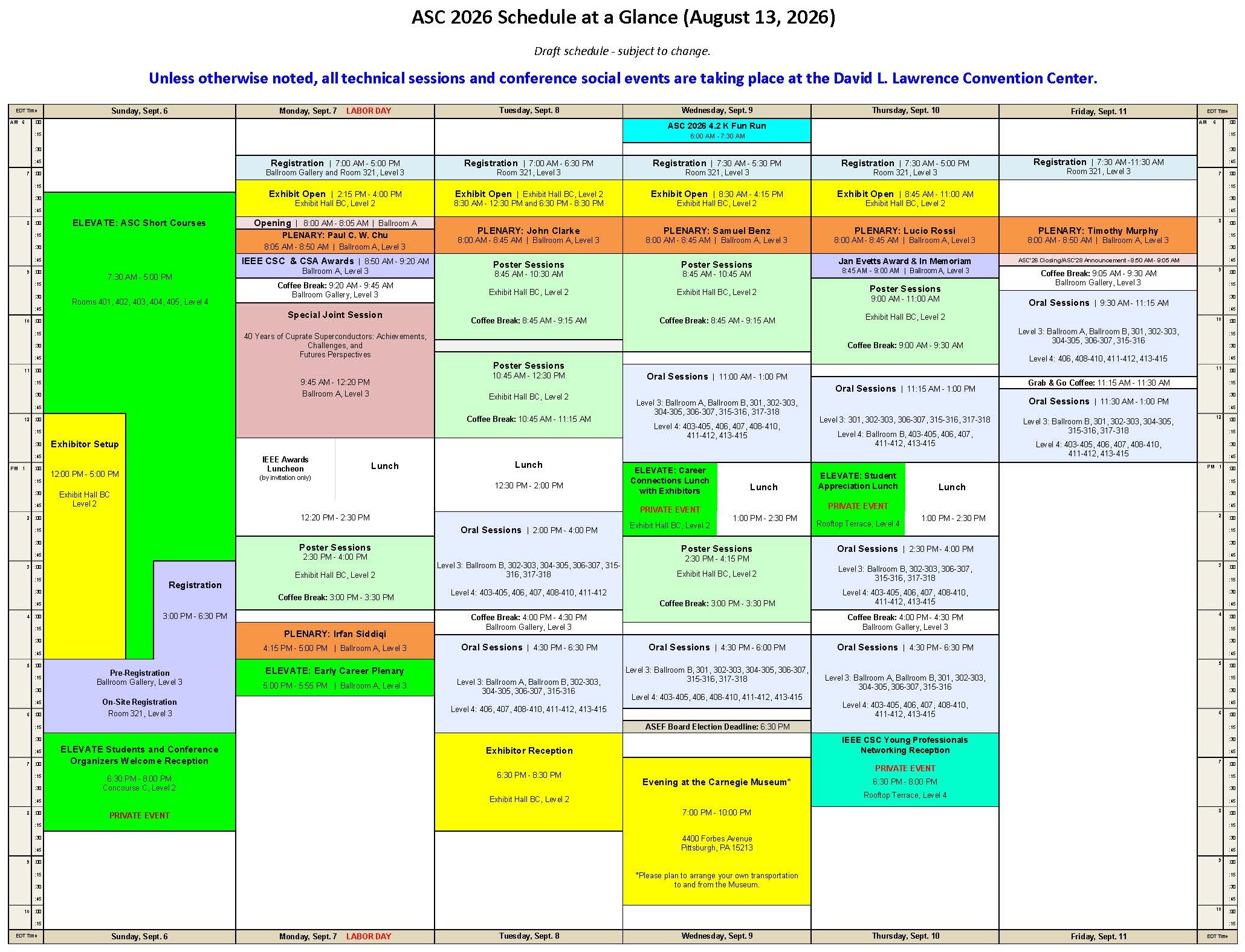
The ASC 2026 Conference Organizers & Program Committee occasionally need to make changes to the program. We urge you to check the schedule before and during the conference for last minute changes.

Click on the image below to open the Draft Schedule at a Glance in PDF format.


Authors

Authors

Abstract Submission and Presentation Guidelines

  • Virtual Abstract Writing Workshop: A free Virtual Abstract Writing Workshop will be offered on January 15, 2026, to support students and early-career professionals in developing high-quality abstracts. The workshop will provide examples of effective abstracts, highlight common pitfalls, and offer practical guidance for non-native English speakers. Participation is optional but strongly encouraged for all prospective authors. Click here for details.
  • Presentations are either oral or poster. The Program Committee reserves the right to change the type of presentation from that preferred by the author to accommodate limitations on meeting space and other constraints.
  • Presentation is a requirement for a submitted manuscript to be considered for peer review. This includes presentations in oral or poster format. The presentation should be given at the appointed time in the program, by the designated author or co-author (presenter). Only manuscripts based on material presented in an oral presentation or on a poster will be considered for publication. For poster presentations, the presenting author must be present during the assigned session and available for discussion. Simply displaying pages from a manuscript does not constitute a presentation.
  • The abstract submitter will become the contact author for the manuscript submission. Manuscript submission is optional.
  • Manuscript preparation and submission information can be found here.
  • Acceptance of an abstract and its presentation (whether oral or poster) does not guarantee that the related manuscript will be accepted for publication.

PRESENTATION GUIDELINES OVERVIEW

Important Policies at a Glance

  • The presenting author or representative must be a registered Conference attendee. Registration details are available here.
  • Presentations must be delivered in person in Pittsburgh. Virtual and hybrid presentations are not supported.
  • Accepted abstracts that are not presented as scheduled will be considered “no-show” abstracts.
  • Poster presenters must remain at their posters during the assigned session period.
  • Presentation formats are assigned by the Program Committee and may be adjusted based on program needs.
  • Abstract changes must be submitted by August 3, 2026.
  • Abstracts accepted for presentation will be published in the official conference program and made publicly available prior to the conference.
  • All presentations must be delivered in English.
  • Authors are fully responsible for the accuracy, originality, and proper authorship of all submitted materials, including content generated or modified using AI-based tools.
  • The registration fee includes one manuscript submission for a presented abstract included in the conference program. Additional manuscript submissions for other presented program abstracts may be purchased for an additional fee. See the Publication page for detailed information.
  • A single presenter registration may cover multiple presentations by the same presenting author. Please note that the registration fee includes only one manuscript submission; additional manuscript submissions require payment of the applicable publication fee.

CALL FOR ABSTRACTS & PAPERS

General Information

  • Abstract submission opens Wednesday, December 10, 2025. 
  • Presentations are either oral or poster. The Program Committee reserves the right to change the type of presentation from that preferred by the author to accommodate limitations on meeting space and other constraints.
  • Abstract submission extended deadline: 11:59 PM EST, Monday, February 2, 2026.  This deadline is firm! Abstract submissions are no longer accepted except for the extreme circumstance of presenting last minute, ground-breaking research. In such cases, please contact Centennial Conferences by email with your abstract be sure to include the appropriate submission category. Abstracts will be sent to the Program Committee Chairs for possible consideration at the committee’s discretion.
  • After the abstract submission deadline, abstracts will no longer be accepted except for the extreme circumstance of presenting last minute, ground-breaking research.
  • Abstract acceptance notifications will be emailed to the submitting and presenting authors on March 16, 2026.
  • Acceptance of an abstract and its presentation (whether oral or poster) does not guarantee that the related manuscript will be accepted for publication.
  • All presenting authors on accepted abstracts must register for the conference and present their work in person in Pittsburgh. Virtual or hybrid presentations are not supported.

Scope of Submissions and Topic Areas

Submissions shall generally address at least one of the areas below. Click here for the full list of submission categories.

  1. Applications of superconductors in Quantum Systems – Quantum Computing / Communications / Sensing. The most promising modalities for implementing the relatively new field of quantum information involve superconducting devices, superconducting qubits, and/or superconducting readout systems. ASC invites submissions related to Quantum Systems that include superconductors. Device, design, packaging, system related topics are included and solicited.
  2. Advances in the science of superconductors relevant to applications. Abstracts describing basic materials, films, or artificial structures should discuss properties interesting for applications, forms used in applications such as elementary conductors or simple circuits, or structural or compositional aspects that potentially lead to use in a device. Theoretical content should address topics relevant to applications, operations, or behavior of practical systems. Experimental studies, test methods, and data should relate to aspects of superconductivity important for applications in some way.
  3. Advances in superconducting technology. Abstracts may describe concepts, design, modelling, manufacturing or fabrication, and operation or implementation of superconducting devices or components. Extensions of conventional technologies by the use of superconductivity should emphasize the role of superconductivity in the device or component. Abstracts may describe non-superconducting technologies that are required for the use of superconductors, such as insulation, provided that the primary discussion is focused on applied superconductivity.
  4. Integration of superconducting devices and components in systems. Abstracts may discuss sub-systems or full systems comprised of components such as cables, magnets, detectors, circuits, and so on. Discussions may include components and processes that support superconducting devices, such as cryogenic systems supporting superconducting magnets. Studies of power devices, transportation systems, electricity transmission, energy storage, and other systems that use superconducting components should emphasize the role of superconductivity or the particular aspects of superconductivity important to the system or application. Cryogenics, non-superconducting materials at cryogenic temperature, power supplies, power electronics, and other ancillary topics may be considered provided the connection to applied superconductivity is clear. Also, abstracts may describe facilities to verify operation of components, report system tests, or describe the status of superconducting systems and projects using superconducting components.

Note that the numbers are related to editorial subject areas of the IEEE Transactions of Applied Superconductivity (TAS). A submission category must be selected during abstract submission.

Abstract Preparation & Submission Guidelines

  • All abstracts must be about applied superconductivity, must be written in the English language, must contain enough information to permit placement of the presentation into the program, and must make logical arguments based on scientific or engineering methods. The Program Committee reserves the right to reject abstracts that do not conform to these guidelines.
  • Abstracts must be submitted via the ASC 2026 abstract submission site.
  • Only the abstract title, abstract body (text only), and authors are required.
  • Abstract Submission Checklist:
    • Ensure your abstract contains sufficient information for reviewers to determine its scientific quality.
    • Ensure your abstract is about applied superconductivity and explain the relevance.
    • Ensure your abstract is scientifically meaningful or otherwise descriptive of a substantial development in the ASC community and does it explain why.
    • Length restrictions include spaces and are as follows:

♦ Title and Abstract Content/Body: 3000 characters
♦ Acknowledgment: 300 characters

  • Formatting may be performed by the abstract management system, please prepare your abstract in plain text.
  • Abstract titles must be in mixed/sentence case.
  • Some symbols (e.g., Greek letters) can be used in the abstract submission, however, if your symbol does not paste correctly (you should be able to see it on the screen), then please substitute the corresponding plain text.
  • All co-authors must be included in the abstract submission site with a valid email address. If you have a large collaboration author list, you may provide a collaboration email address. However, only authors explicitly entered into the submission site will be displayed in the online planner for attendee viewing.
  • A confirmation step will permit authors to verify all content and give final approval. Only completed submissions will be reviewed for technical program consideration. Draft submissions will not be considered.
  • Submitting authors are responsible for the accuracy of all submitted information.
  • The control number assigned to an abstract once it is submitted is the primary means of identifying an abstract until the program is formed. Please use the control number in any correspondence concerning abstracts until a program number has been issued.

Abstract Changes & Withdrawals

Abstract Changes & Modifications

Authors may modify abstracts until the deadline using the abstract submission site unless the submission has already been reviewed by the Program Committee.

If your abstract has already been reviewed and after the submission deadline, abstract content changes, i.e., modification of title or body, will be sent to the Program Committee for approval. Corrections, i.e., spelling or grammar, or author changes such as designation of different presenting author, changes to affiliations, changes to names, etc., can be completed without referral to the Program Committee. In either case, please contact Centennial Conferences by e-mail and specify whether you need a change or a correction in the e-mail subject line along with the Control ID.

Except for presenting author changes, modest abstract modifications will be accepted until August 3, 2026.

Abstract Withdrawals

  • Abstracts can be withdrawn via the abstract submission site through the abstract submission deadline.
  • Withdrawal requests after closing of the submission site must be sent to Centennial Conferences by e-mail. Please be sure to include your Control ID.

Disclosure

  • Abstracts will be reviewed by the Program Committee.
  • Submitting author email addresses will be added to the ASEF (ASC) email list (if not already on the list) to ensure that conference announcements are received.
  • All abstracts submitted are disclosed to members of the ASC 2026 program committee and conference management. Abstracts accepted for presentation are made available publicly with launching the full conference program prior to the conference.

Questions?

For questions, please contact Centennial Conferences by email at asc@centennialconferences.com.

Copyright 2026 Applied Superconductivity. All rights reserved